Please Sir, I Want Some Moore
There is one thing and only one thing that is for sure, no one truly knows the future. But with a twist, we can, in fact, forecast and sometimes even predict it. If I may say it again, it's all in the definition and the twist of words. According to the Cambridge Dictionary (n.d.), a forecast is "a statement of what is judged likely to happen in the future, especially in connection with a particular situation, or the expected weather conditions." Accordingly, just as a weatherman forecasts the weather, people or businesses can forecast and predict future innovation and its impact within that context. Sometimes these predictions are wrong but call it an educated guess if you will, but they are found to be accurate more often than a blind one.
The Intel on Moore
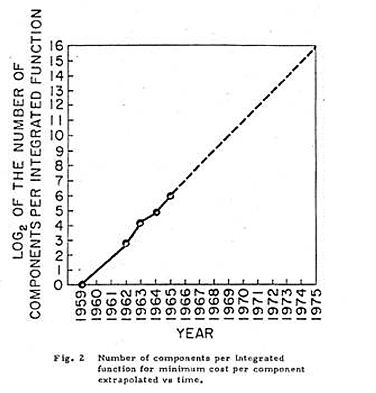 | |
| Moore's Law graph, 1965 |
One such example finds Gordon E. Moore authoring the article "Cramming More Components Onto Integrated Circuits," found in the April 1965 edition of Electronics Magazine, three years before co-founding Intel (Singer & Franco, 2021). In that paper, based upon Fairchild Semiconductor's previous five years of integrated circuit (IC) design, Moore predicted that the transistor count would double every year for at least a decade. In the years since Intel has been a dominant force in the market, Moore's law has been commonly discussed in the computing community ever since Carver Mead coined the title around 1975 (Gianfagna, 2021). Moore's law proves remarkably accurate in predicting that ICs would continuously improve due to the developers' dedication to continuously improving them (Intel, n.d.). Accordingly, by 1975 a state-of-the-art microchip was manufactured with 65,636 transistors and accurate within a single percent of the quoted 65,000 for that decade.
IC Driving Forces
In 1959, six years before Moore wrote the paper that would turn into "Moore's Law," Robert Noyce had conceived the integrated circuit (Intel, n.d.). Immediately following Noyce's innovation, the military held the primary interest in it and its possible application. However, as engineers continued to enhance the technology, ICs steadily grew in complexity while continually dropping prices.
Which leads us back to the infamous "Cramming More Components onto Integrated Circuits" paper, where Moore astutely anticipated other potential applications other than with the military for these future chips (Moore, 2006; Intel, n.d.). "Integrated circuits will lead to such wonders as home computers[,] … automatic controls for automobiles, and personal portable communications equipment." Further, Moore (2006) stated microchip-based technologies would become "more generally available throughout all of society, performing many functions that presently are done inadequately by other techniques or not done at all."
References
Cambridge Dictionary. (n.d.). Meaning of forecast in English. Retrieved March 31, 2022, from https://dictionary.cambridge.org/us/dictionary/english/forecast
Moore, G. E. (2006). Cramming more components onto integrated circuits, Reprinted from Electronics, volume 38, number 8, April 19, 1965, pp.114 ff. IEEE Solid-State Circuits Society Newsletter, 11(3), 33–35. https://doi.org/10.1109/n-ssc.2006.4785860
Gianfagna, M. (2021, June 30). What is moore's law? – an overview. Synopsys. https://www.synopsys.com/glossary/what-is-moores-law.html
Intel. (n.d.). Moore's law. Retrieved March 31, 2022, from https://www.intel.com/content/www/us/en/history/virtual-vault/articles/moores-law.html
Singer, G., & Franco, J. (2021, November 4). In Hindsight. . . Tech predictions and quotes. TechSpot. https://www.techspot.com/article/754-tech-predictions-and-quotes/


Comments
Post a Comment